
Introduction
Brushless DC motors — commonly known as BLDC motors — are rapidly becoming the preferred choice across a wide range of industries. From energy-efficient ceiling fans and home appliances to electric vehicles and industrial drives, BLDC motors offer a compelling combination of high efficiency, long lifespan, and low maintenance.
But as demand for BLDC motors surges, manufacturers face a critical challenge: winding BLDC stators is significantly more complex than winding conventional motors.
What Makes BLDC Stator Winding Different?
Unlike traditional AC induction motors, BLDC stators require:
- Tight turn-count accuracy — even a single missed turn affects motor performance
- Precise wire tension control — inconsistent tension causes hotspots and early motor failure
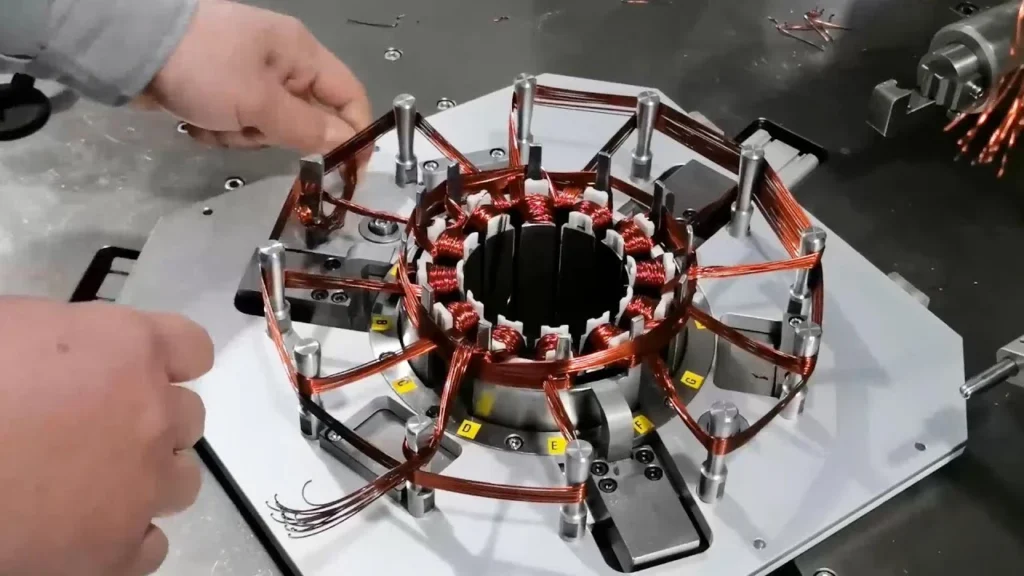
- Multiple pole winding — BLDC stators often have 9, 12, or 18 slots requiring sequential, precise winding
- Compact coil placement — BLDC designs leave very little tolerance for winding errors
Manual winding of BLDC stators is not just slow — it is practically impossible to scale without sacrificing quality.
The Role of Automatic BLDC Winding Machines
Automatic BLDC stator winding machines are specifically engineered to handle these demands. With programmable multi-pole winding sequences, digital tension control, and high-speed needle or flyer mechanisms, they deliver:
- Consistent turn counts across every pole and every unit
- Uniform wire tension throughout the winding process
- Faster cycle times — up to 3x faster than manual winding
- Seamless switching between different stator configurations
The result is a BLDC stator that meets strict performance specifications — every time, at scale.
Why This Matters for Your Business
The BLDC motor market is growing rapidly. Manufacturers who can produce high-quality BLDC stators efficiently and cost-effectively will capture a significant share of this expanding market. Those who rely on outdated manual processes will struggle to compete on quality, speed, and price.
Investing in automatic BLDC winding technology is not just an operational upgrade — it is a strategic business decision.
AR Engineering’s BLDC Winding Solutions
Our Automatic BLDC Stator Winding Machine and BLDC CW01 are designed from the ground up for the demands of modern BLDC motor production. With over 15 years of winding machine expertise, we understand the precision requirements of BLDC stators — and we build our machines to exceed them.
Conclusion
BLDC motors are not a trend — they are the future of efficient, sustainable motor technology. Your winding process needs to be ready for that future today.
Get in touch with AR Engineering to learn how our BLDC winding machines can transform your production capabilities.